
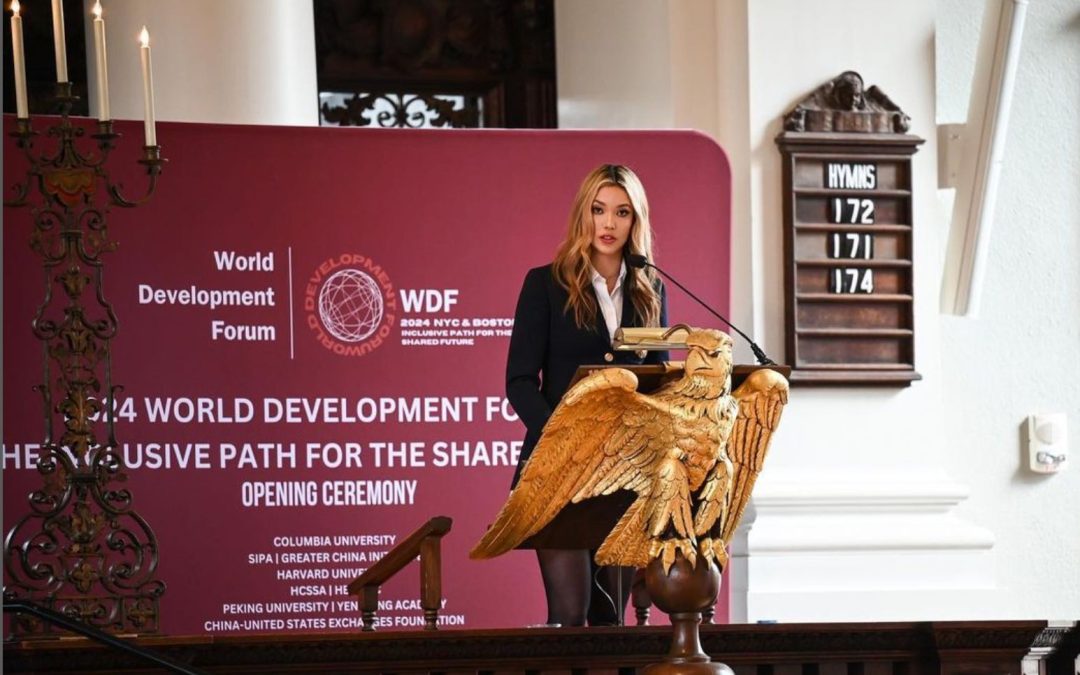
Eileen Gu urges us not to view youth as a burden, but rather as a strength, especially in times of great uncertainty like the present, like with wars, a resurgence of the fight against inequality, and climate crises. Gu notes that being young today is not means being naive; with current resources this can become an empowering situation.
She recounts how her personal and professional experiences have allowed her to broaden her perspective, noting how interactions in a context of diversity and the cultivation of knowledge beyond the confines of a classroom enabled her to break through what she considered to be “stubborn mental barriers” typical of youth.
Eileen presents a personal concept she calls “critical curiosity,” which she describes as the practice of approaching new topics with both an “educated mind and an open heart.” In her own words, she expresses that being curious is a sign of humility, and being humble is a sign of a willingness to be wrong. She recounts experiences that tested her perseverance and resilience, where she had to draw on her “warehouse” of knowledge to come up with a plan on the spot. She also explains how, in her view, school provided her with a toolbox, while training showed her how to expand those tools to more areas of her life. He states that this mindset can combat modern misinformation, mentiong that closed minds become corrosive, and invites the audience to recognize that differences are not our weakness, they are our strength.
On the topic of courage, he shares another story where he was in third place in an Olympic competition, and although the only way to win was to attempt a very dangerous maneuver, he realized it was time to put into action the words he preached about courage, considering the impact that might have on the representation of young athletes around the world.
She concludes by encouraging young people to recognize themselves as a formidable force, not to wait until they are “grown up” to seek to change the world, and for each person to do their part to make the world a better place.
In my opinion, Eileen Gu demonstrates traits of the five major personality dimensions (OCEAN) in the following areas:
- Openness (O): Gu demonstrates a wide range of intellectual, professional, and academic interests; she describes how diverse experiences broaden horizons. Openness allows her to synthesize learning from various fields to create innovative solutions.
- Conscientiousness (C): She mentions viewing education as a “toolbox” and her willingness to fail, and also highlights organization and diligence. This translates “crazy” ideas into achievable processes through systematic practice, planning under pressure, and persistence in acquiring new skills.
- Extraversion (E): Gu undertakes personal and professional endeavors such as the fashion industry, Olympic competitions, and high-level academic events, often with audiences that can reach millions of people, and addresses the audience in two languages, honoring her mixed cultural heritage. These traits help her feel calmer in moments of tension, demonstrate energetic leadership and collaboration, and amplify her impact through her ability to communicate with her own voice.
- Agreeableness (A): Emphasis on collaboration, humility, and framing differences as strengths. This fosters trust and influence, enabling her to use her achievements to inspire others.
- Neuroticism (N): It involves doubts, “stubborn mental barriers,” and emotional moments, yet she repeatedly demonstrates resilience. This pattern suggests some normal stress reactivity but effective emotion regulation and recovery. Lower neuroticism allows her to take calculated emotional risks without being debilitated by fear; a measured amount of worry may sharpen caution but does not prevent bold action.